Juli Aoxuan Technology (Zhejiang) Co., Ltd.
Founded in 1989, the Group has specialized in the industry for 37 years as a professional provider of automated motor winding solutions. Recognized globally by leading electric vehicle brands and motor suppliers, we offer customers turnkey one-stop services covering everything from product R&D to automated mass-production lines.
Founded in 1989, JULI Group embarked on its journey with the establishment of JULI Electrical Machinery Equipment in 1997, laying a solid foundation for its core business. In 2006, JULI Automation China was founded, marking a key step in strengthening the Group's presence in the automation industry. The year 2011 saw the establishment of JULI Technology, which was later renamed JULI Aoxuan Technology in 2020 to support the Group's ongoing technological upgrade. In 2015, the Group significantly expanded its global footprint and capabilities by acquiring Switzerland's SMZ Wickel- und Montagetechnik AG, a historic enterprise with roots dating back to 1913. Building on this momentum, the Group launched SMZ JULI AUTOMATION EUROPE KFT. In Hungary in 2024, followed by the establishment of JULI AUTOMATION SERBIA LLC in Subotica, Serbia, in 2025, further advancing its strategic layout in Europe. Looking ahead, the Group's new headquarters in China, covering 55,000 square meters of land with a total building area of 128,000 square meters, is scheduled to open in 2027, serving as a new cornerstone for the Group's continued growth and innovation.

Over the past six years, JULI has achieved rapid growth in both headcount and revenue. Our team capabilities have been steadily enhanced and market performance has remained outstanding, which fully demonstrates our strong development momentum in the automation equipment sector and wide recognition across the global market.
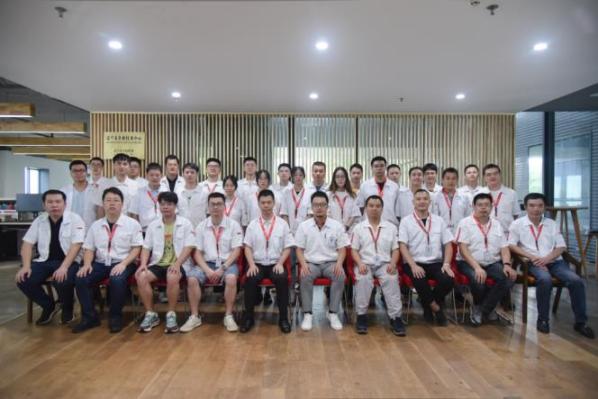
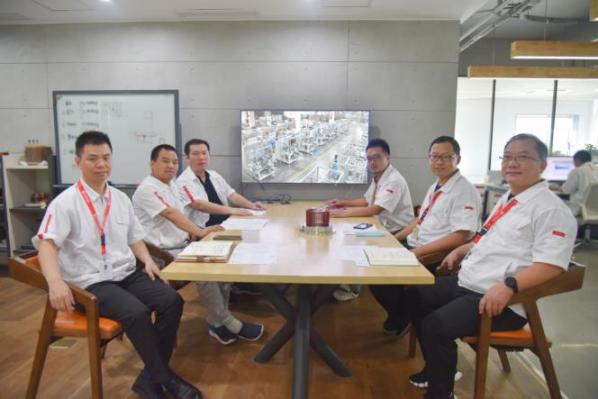
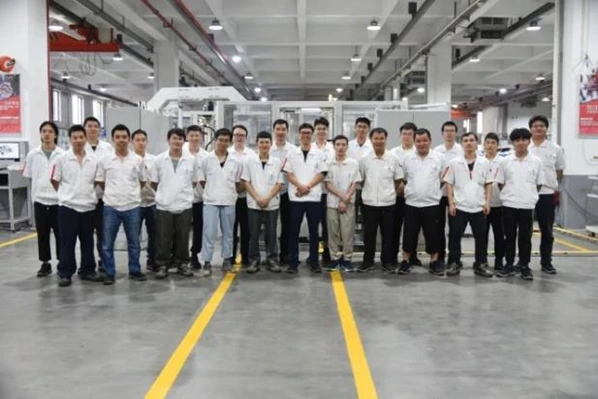
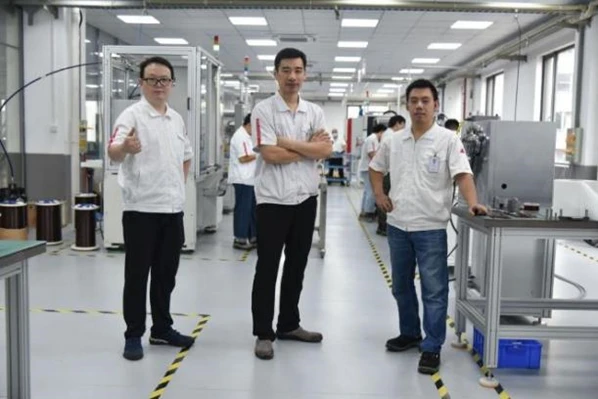
JULI company has built a strong R&D and assembly team. We have over 140 R&D engineers, including more than 15 senior engineers with over 15 years of industry experience and over 35 engineers with 5 to 10 years of experience. The assembly team consists of more than 200 seasoned front-line staff. Among them, over 50 assembly technicians have worked in the industry for more than 10 years, and over 80 have 5 to 10 years of working experience. We operate three major assembly and production bases with a total workshop area of 26,000 square meters. Our ample production capacity enables us to fully meet diverse production requirements from customers.
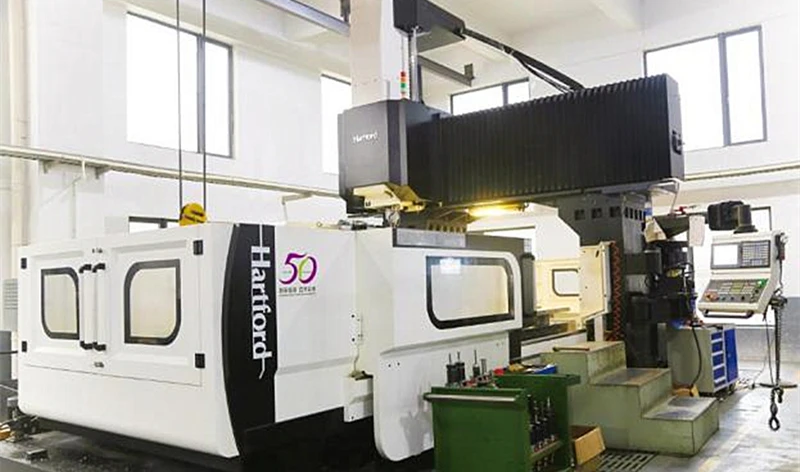
The company boasts strong in-house machining capabilities. With a 5,800-square-meter machining workshop and over 158 sets of high-end processing equipment, we realize independent production of core components. This ensures product precision and on-time delivery, enables quick response to customized requirements, and builds a solid manufacturing foundation for stable and efficient delivery of automated production lines.

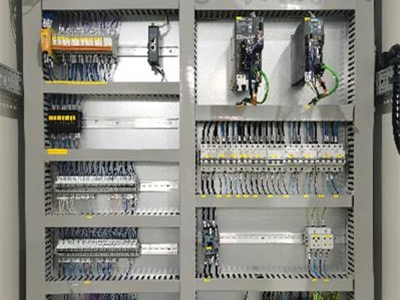
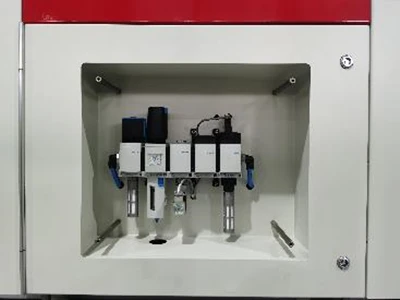
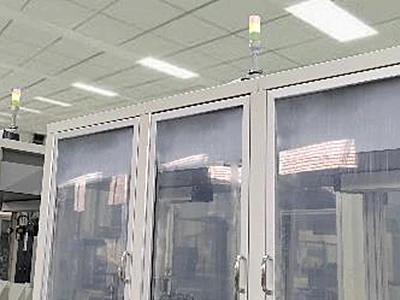
Our automated production lines are manufactured in strict compliance with international manufacturing standards. From core electrical control to full-line system integration, we adopt components from world-leading brands and proven technologies. The electrical cabinets feature neat and standard wiring. The HMI interfaces are intuitive and user-friendly. Pneumatic and safety systems are fully optimized. With well-organized line layout and complete safety protection facilities, our equipment fully meets global clients' stringent requirements for stability, safety and maintainability, delivering solid quality assurance for product export and international business expansion.

Future EV Drive R&D Lab – Aoxuan Technology
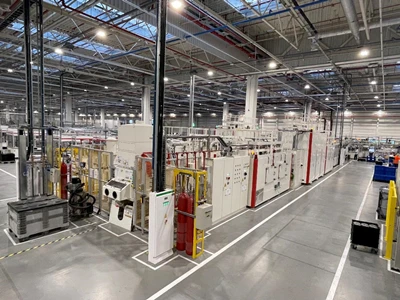
Aoxuan Technology's Future EV Drive R&D Lab is a dedicated innovation and validation platform for advanced electric motor manufacturing technologies. Designed for flexibility and modularity, it covers the full spectrum of stator production processes, enabling comprehensive R&D and prototype verification for various motor architectures.

The lab integrates key stations for both hairpin/flat wire motor and traditional winding technologies:
• Hairpin Stator Process: Features automatic paper forming, wire insertion, twisting, trimming, and advanced pin forming (supporting U-shape, 3D, and laser forming), followed by laser/TIG welding for high-precision connection.
• Winding Technologies: Equipped with flyer winding and multi-winding-in-one systems to validate optimized winding strategies for different motor designs.
• Insulation & Post-Processing: Includes trickling impregnation, epoxy application, and modular curing ovens to ensure robust electrical insulation.
• Testing & Logistics: Integrates weighing, functional testing, and test storage stations. A ground rail + robotic system enables flexible material handling between stations, supported by dedicated tooling storage.
This lab allows Aoxuan to develop, test, and refine custom assembly solutions from early prototypes to production-ready processes, ensuring reliable, scalable automation lines for global EV and motor customers.
Technology Introduction
1. Winding technology development
Winding technology Development
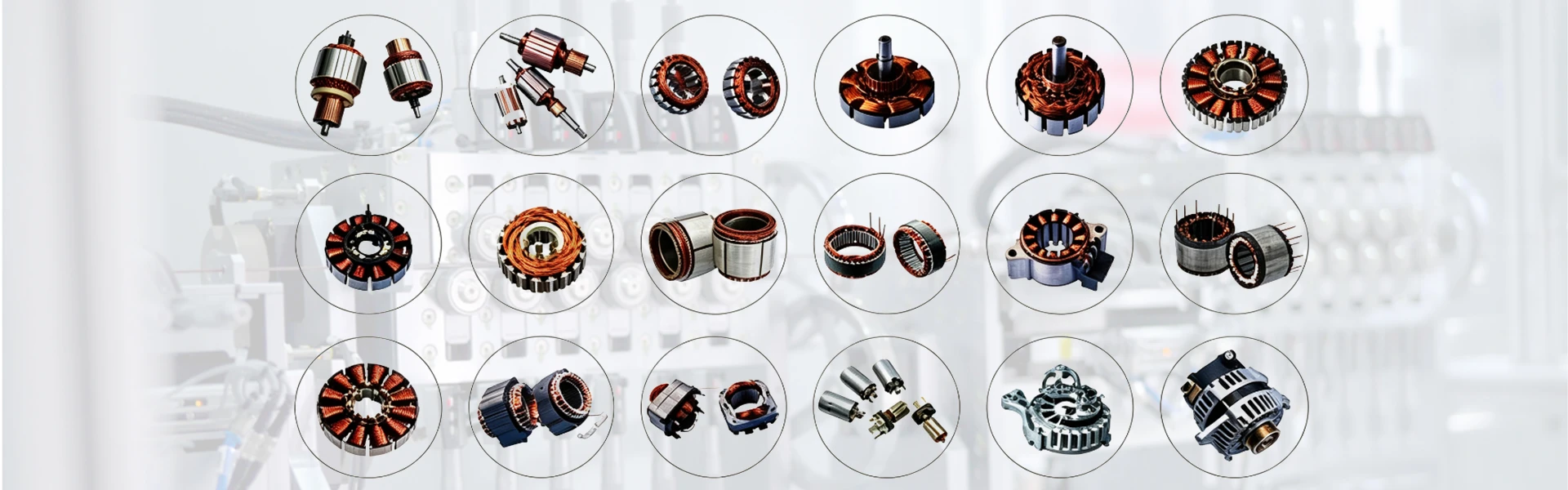
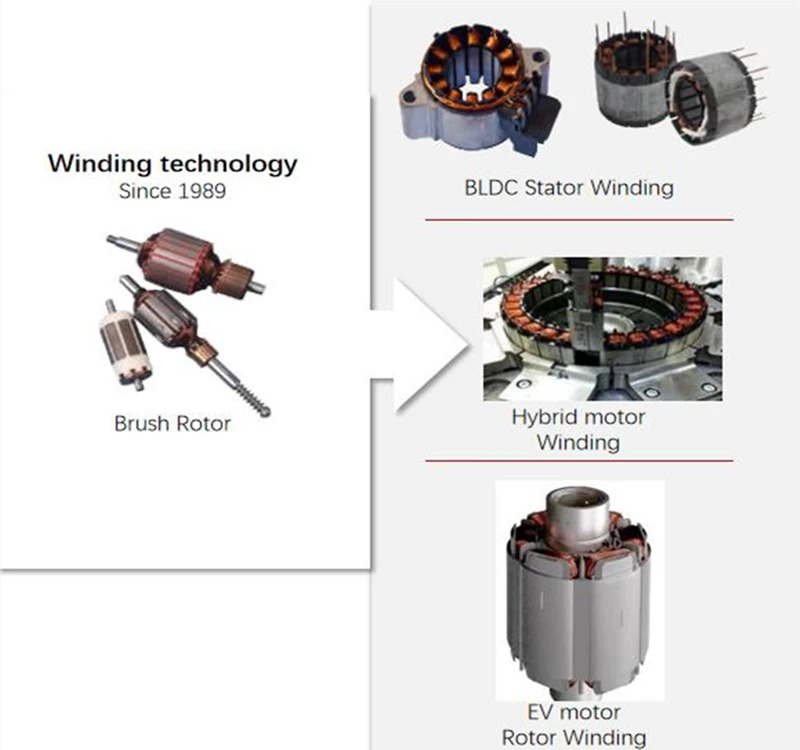
Since 1989, we have pioneered and refined motor winding technology to keep pace with evolving market demands. Our journey began with core solutions for brush motor rotor winding, serving traditional automotive and industrial applications.
Over decades of innovation, we expanded our expertise to support a broader range of advanced motor types, including:
BLDC Stator Winding: Delivering precise, high-efficiency winding for brushless DC motors, widely used in home appliances, power tools, and new energy applications.
Hybrid Motor Winding: Developing flexible solutions for hybrid powertrain motors, balancing performance, reliability, and cost-effectiveness.
EV Motor Rotor Winding: Providing high-volume, consistent winding processes for electric vehicle traction motors, meeting the strict requirements of the global automotive industry.
Building on our foundational winding capabilities, we continuously optimize processes, tooling, and automation to ensure stable quality, improved efficiency, and full adaptability to custom motor designs.
Hairpin Technology Development
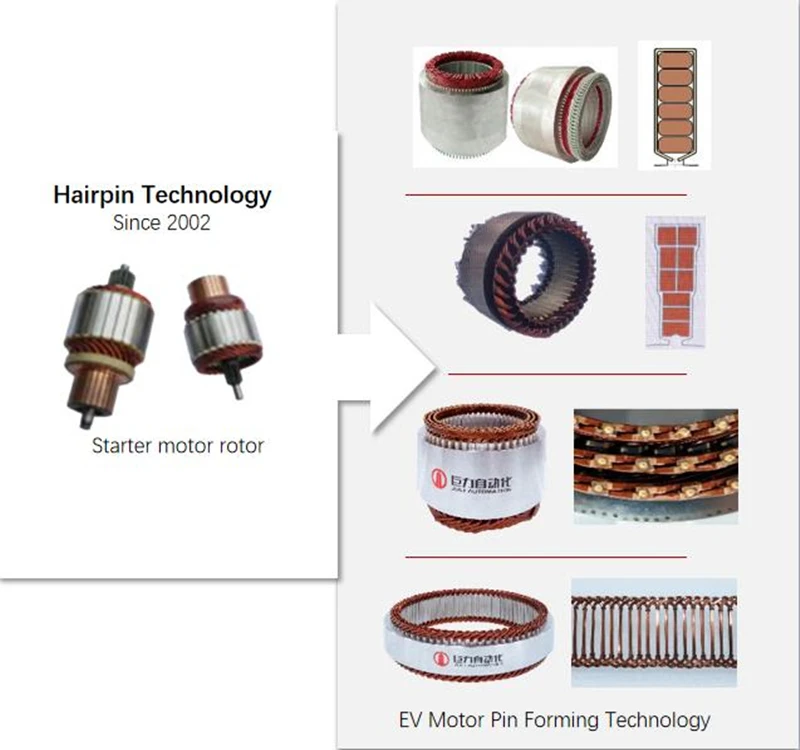
In 2002, we began our exploration of hairpin technology, starting with applications for starter motor rotors. As the global shift toward electrification accelerated, we evolved our solutions to meet the high-performance demands of electric vehicle (EV) motors.
Today, our mature EV Motor Pin Forming Technology covers the full process chain of flat wire motor manufacturing, including precision forming, twisting, welding, and insulation. We support diverse hairpin topologies, from basic U-pin designs to advanced multi-turn and segmented configurations, enabling our customers to achieve higher power density, lower resistance, and improved thermal performance in their EV motors.
This continuous evolution, from conventional winding to cutting-edge hairpin solutions, reflects our commitment to driving innovation in motor manufacturing technology.
2. Assembly technology development
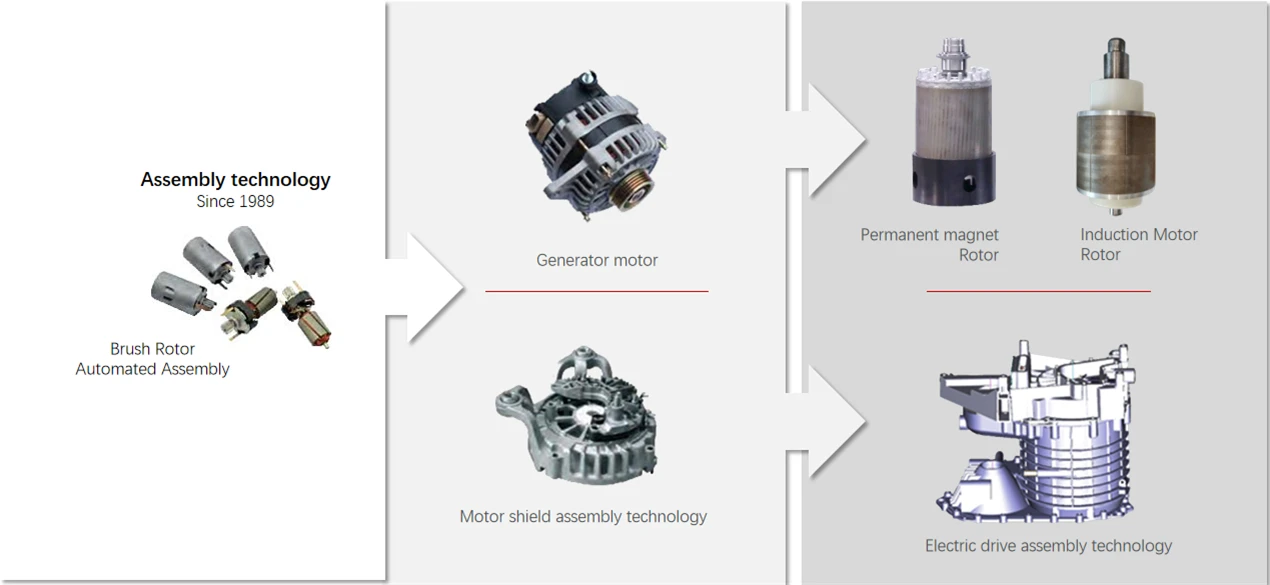
Since 1989, we have continuously advanced our motor assembly technology to meet evolving market requirements. Our journey began with automated assembly solutions for brush motor rotors, establishing a solid foundation in precision and efficiency for traditional automotive and industrial applications.Over the decades, our assembly capabilities have expanded significantly to cover a wide range of motor types and components:
Generator Motor Assembly: We developed reliable assembly processes for automotive alternators, ensuring consistent performance and durability under demanding operating conditions.
Motor Shield Assembly Technology: Building on our experience, we introduced advanced assembly solutions for motor housings and shielding, improving protection and thermal management.
As the global shift toward electrification accelerated, we evolved our assembly technology to support the new energy era:
Permanent Magnet & Induction Motor Rotor Assembly: We provide high-precision assembly lines for both permanent magnet and induction motor rotors, tailored to meet the high power density and reliability standards of modern electric vehicles.
Electric Drive Assembly Technology: Our most advanced capability covers the full assembly of electric drive units (EDUs), integrating motors, gearboxes, and control systems into complete, production-ready solutions.
This continuous evolution, from simple brush rotor assembly to comprehensive electric drive system integration, demonstrates our commitment to delivering scalable, high-quality automation solutions for the motor industry.
3. Hairpin stator technology development
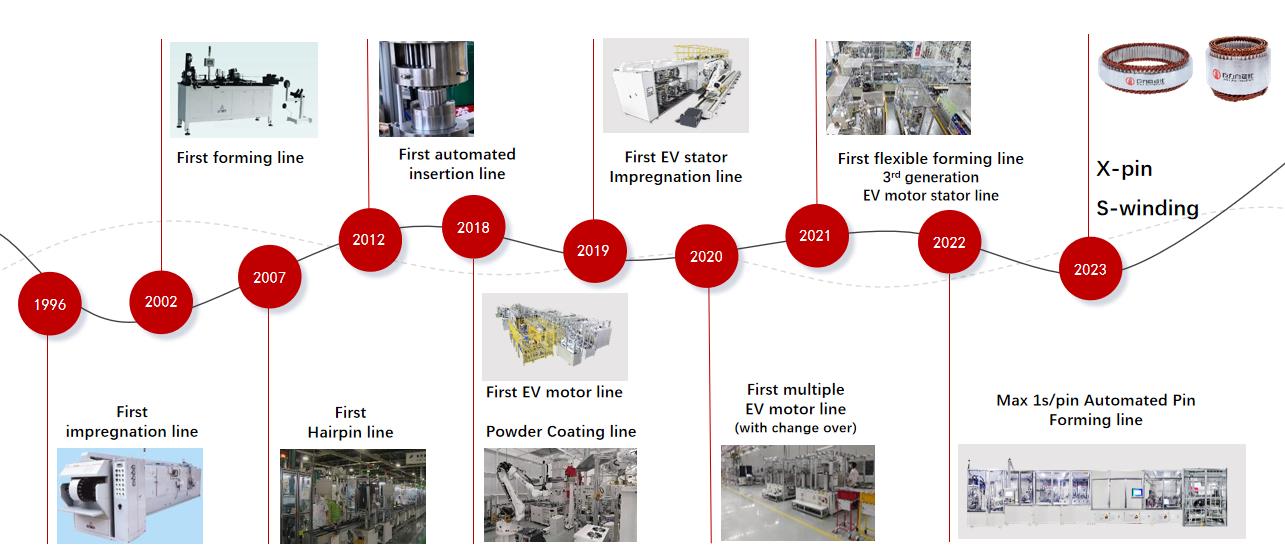
Our hairpin stator technology development spans nearly three decades: starting with the first stator impregnation line in 1996, we launched our first dedicated hairpin production line in 2007, marking our formal entry into the field. As the EV market grew, we delivered our first EV stator impregnation line in 2019, laying the foundation for high-volume, high-voltage motor production. In 2021, we introduced our third-generation flexible forming line, significantly boosting production efficiency and model adaptability. Most recently, in 2023, we expanded our capabilities to include X-pin and S-winding solutions, supporting the next generation of high-performance electric motors.
4. Full-stack self-developed hairpin flat wire technology
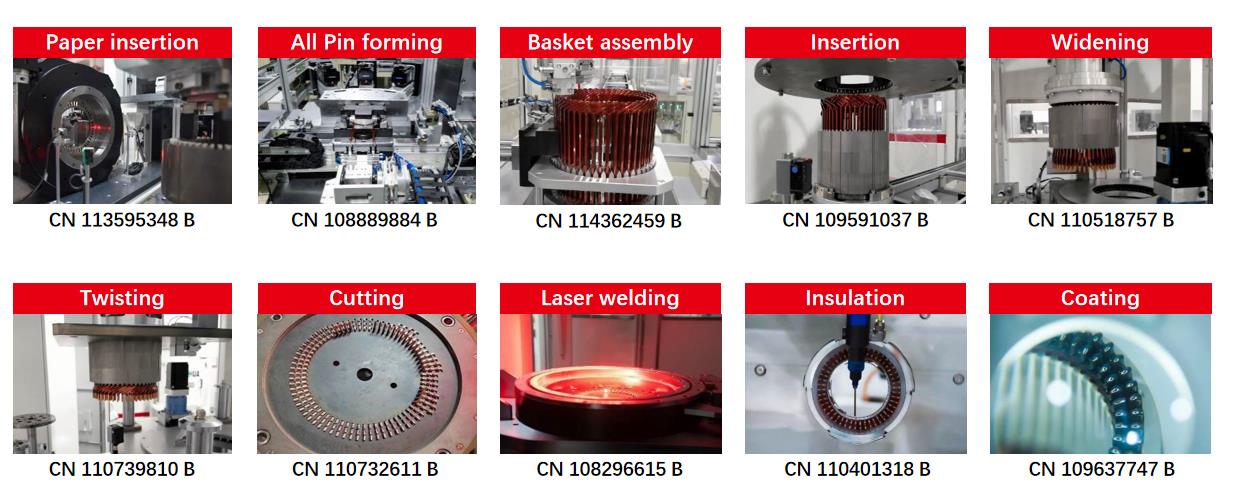
Our full-stack self-developed hairpin flat wire technology covers the entire manufacturing process of hairpin stator production. From the initial paper insertion and all pin forming, through basket assembly, insertion, widening, twisting, and cutting, to the final stages of laser welding, insulation, and coating, every core process and key equipment is independently developed and mastered in-house. This full-process capability ensures high precision, stable quality, and flexible customization, enabling us to deliver efficient, reliable production lines tailored to diverse EV motor requirements.
5. Hairpin stator technology development
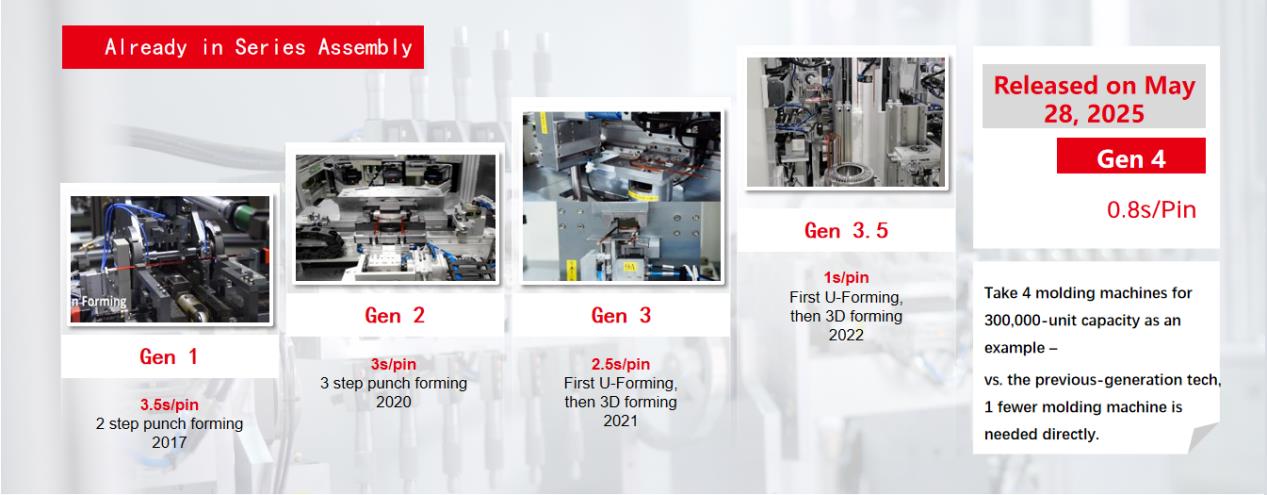
Our hairpin pin forming technology has evolved through multiple generations, delivering continuous breakthroughs in cycle speed and process capability.
From Gen 1 in 2017 (3.5s/pin) to Gen 4 launched in May 2025 (0.8s/pin), each iteration has significantly reduced forming cycle times, while evolving from basic punch forming to advanced 3D and U-forming processes. The latest Gen 4 sets a new benchmark in speed, enabling higher-volume, more flexible hairpin stator production to meet the growing demands of the EV industry.